A Republic, if We Can Keep It
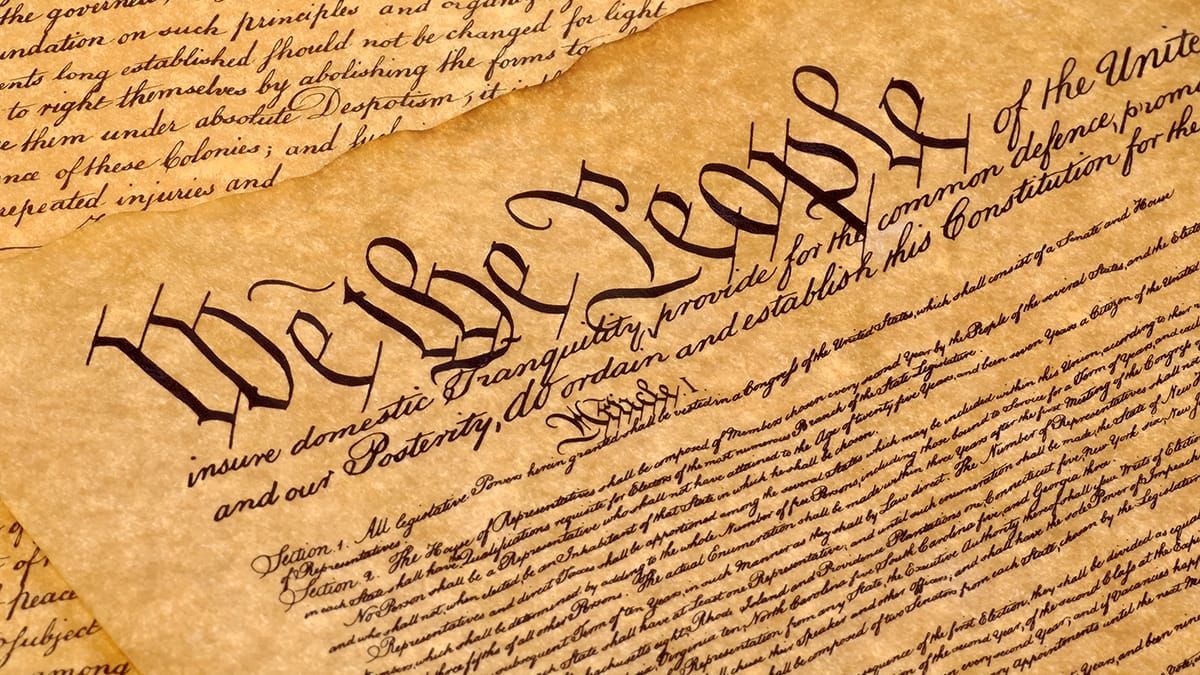
On September 17, 1787, the Constitutional Convention came to a close in Philadelphia. After months of debate, compromise, frustration, and uncertainty, the delegates had produced a proposed Constitution for the United States.
Benjamin Franklin, then eighty-one years old and too physically weak to deliver his own final speech, had it read aloud by Pennsylvania delegate James Wilson. In that speech, Franklin conceded that the Constitution was far from perfect, but he urged the delegates to support it with humility for the sake of the country.
According to a story recorded by Maryland delegate James McHenry, as Franklin left the Convention, Elizabeth Willing Powel of Philadelphia asked him what kind of government the delegates had just given the country: “a republic or a monarchy?” In other words, would America be ruled from a throne, or entrusted to the hands of its people?
Franklin’s answer has echoed ever since:
“A republic, if you can keep it.”
Not, “A republic, because we have solved all the problems.”
Not, “A republic, because history is now on our side.”
Not, “A republic, because our institutions will preserve themselves.”
“… if you can keep it.”
If a monarchy’s survival hangs on whether its ruler can be trusted, a republic, perhaps more frighteningly, depends on whether the people can be.
A republic may be established by documents, conventions, votes, and laws, but it must be kept by people. It requires more than a Constitution. It requires citizens capable of self-government.
As we celebrate the nation's 250th anniversary, that little word “if” feels sharper than ever, because the question of “keeping it” is not only whether our institutions can survive, but whether we are still the kind of people capable of self-government.
Then what does it mean to keep a republic?
It cannot mean merely keeping our preferred party in office. Parties rise and fall. Coalitions shift. Elections are won and lost. Administrations change. The balance of power moves from one set of hands to another, and then back again. These things are important, and citizens should not be indifferent to them. They do matter, but they are not the whole of the matter.
That much would be clear within the first three presidencies. The founding generation itself would quickly face parties, factions, bitter elections, contested visions of the country, and deep disagreements about what this republic should become.
If a republic is a form of self-government, then keeping a republic requires more than winning the next election. It requires citizens capable of governing themselves: citizens who can tell the truth, practice restraint, disagree without hatred, lose without despair, win without cruelty, and treat their neighbors as something more than obstacles to be overcome.
The republic is not kept only in Washington, D.C. It is kept around dinner tables, in church foyers, at school board meetings, in workplaces, neighborhoods, comment sections (Lord, help us!), and conversations with people who see the world differently than we do.
And so amid all the celebration of these two hundred fifty years, I have to be honest: One question keeps circling my thoughts…
Can we keep it?
One way to evaluate that question is to listen to how we talk.
I have not written much in this space for quite a while. There are several reasons for that; trying to balance pastoring and piano teaching, trying to attend to my health, grieving my father’s sudden passing.
But more than any of these, the main reason I stopped blogging is simple: I got tired.
Not tired of truth. Not tired of conviction. Not tired of the need to think carefully about hard things. Not even tired of writing.
I grew tired of the way public speech so often turns every tragedy, controversy, election, sermon, scandal, and cultural moment into ammunition.
We have become experts at using words as weapons.
We exaggerate because sensationalism travels faster than carefulness. We mock because mockery rewards us with applause from people who already agree with us. We assume the worst because suspicion feels like wisdom. We speak with certainty about things we barely understand because hesitation looks weak. We turn neighbors into enemies, enemies into monsters, and monsters into people we no longer feel obligated to love.
And then we wonder why trust is disappearing.
This is not merely an online problem, though the internet has certainly poured gasoline on it. The way we speak online trains us in habits that follow us everywhere else. Into our homes. Into our churches. Into our friendships. Into our view of the people down the road who vote differently, worship differently, parent differently, or see the world differently.
A republic cannot be kept by citizens who have forgotten how to speak to one another.
The biggest threat to our republic, I suggest, is not a bad president, a disagreeable Supreme Court decision, or an out-of-touch Congress. Those things may have deep consequences, to be sure.
But the deeper danger to a republic is that we tear it apart from within.
A monarchy may be endangered when the throne is occupied by a fool or a tyrant. But a republic is endangered when the people themselves become too suspicious, contemptuous, dishonest, angry, and divided to share the responsibilities of self-government.
That does not mean agreement is required. It is not. A free people will disagree, and often should. There are real issues worth debating, real evils worth opposing, real lies worth confronting, and real injustices worth decrying. Peace is not the same thing as pretending everything is fine.
But there is a difference between conviction and contempt.
If we cannot tell the truth without exaggeration, disagree without hatred, grieve without exploiting grief, criticize without dehumanizing, and speak with urgency without demanding that everyone else adopt our exact pathos, then we should not be surprised when the republic becomes… harder to keep.
Our influence over what happens in Washington, D.C. may be limited. Politicians will come and go. Parties will rise and fall. Majorities will shift. Administrations will change. But we are not powerless, because those things alone are not what make a republic.
What makes a republic is, well… we the people. And we have stewardship over our own words, our own households, our own churches, our own friendships, our own neighborhoods, and our own conduct.
And if keeping a republic requires citizens capable of self-government, then one of the first tests of that self-government is whether we can govern our tongues… and our keyboards.
Governing Our Tongues
(Before anyone reaches for the Bill of Rights, I said, “Governing Our Tongues”, not “Governing Each Other’s Tongues”)
If this were a sermon, this would be the place where I’d open James chapter 3 and linger over the warning that the tongue, though small, is capable of terrible destruction. James compares it to a small fire that can set an entire forest ablaze. He knew what we seem determined to forget: contrary to the old saying, words can do much more than sticks and stones. Words can bless, heal, clarify, and tell the truth…
And they can also scorch the earth.
So when we talk about preserving a republic, Christians should not think first only of national strategy. We should also think about discipleship. Are we becoming people whose words are governed by truth, love, patience, courage, humility, and restraint? Or are we being discipled by platforms that reward panic, contempt, and tribal rage?
But this is not a sermon. Mostly.
My concern is that a self-governing republic is put in peril when its citizens cannot govern their own words. And Christians, of all people, ought to know something about that.
Let me be clear: For the Christian, preserving the republic is not the goal. Faithfulness to Jesus is the goal. Christians do not pursue discipleship because it is useful for America. We pursue discipleship because Jesus is Lord.
But when Christians become people of truth, restraint, courage, humility, patience, repentance, and love, that faithfulness has civic consequences. It spills outward into our homes, churches, neighborhoods, workplaces, and public life.
The Church does not exist to preserve the republic. But a republic is better off when the Church is faithful to Christ.
Keeping What We Can
So perhaps keeping the republic begins closer to home than we often imagine. Maybe keeping the republic has a lot less to do with legislation, Supreme Court decisions, and White House occupants.
Maybe keeping our republic begins when we refuse to bear false witness, even against people we believe are wrong.
It begins when we stop rewarding panic and contempt simply because they come from our side.
It begins when we tell the truth without embellishment, critique without cruelty, grieve without exploitation, and remember that our political opponents are still our neighbors.
It begins when pastors refuse to let the outrage cycle set the liturgy of the church, and when parents teach their children how to disagree without despising.
It begins when citizens speak with courage and restraint, not because restraint is weakness, but because self-government requires self-control.
So, Can we keep it?
In one sense, that remains an open question. Republics are not immortal. Nations are not eternal. The United States has endured for two hundred and fifty years, but in the long sweep of history, that's not as long as it may feel to us. In a very real sense, we are still living within the American experiment.
So the word “if” still belongs in Franklin’s answer.
But “if” does not have to lead us to despair. It should lead us to faithfulness.
America is worth loving. It is worth serving. It is worth correcting. It is worth giving thanks for. And, where possible, it is worth preserving. Not because it is eternal. No nation is. But because it has been entrusted to us for a time.
So let us do what we can. Let us preserve what is good, reform what is broken, repent of what is evil, and hand something better than rubble to our children. Let us take seriously the ordinary work of citizenship: engagement marked by truth-telling, neighbor-love, patience, courage, restraint, responsibility, and prayer.
And by God’s grace, perhaps we can keep much more than we fear: not perfectly, not permanently, and not as our final hope, but faithfully, for the good of our neighbors and the generations who come after us.
So yes, a republic, if we can keep it.
And let us give ourselves to the work of keeping it, while setting our hope not on any earthly nation, but on the King whose kingdom will have no end.